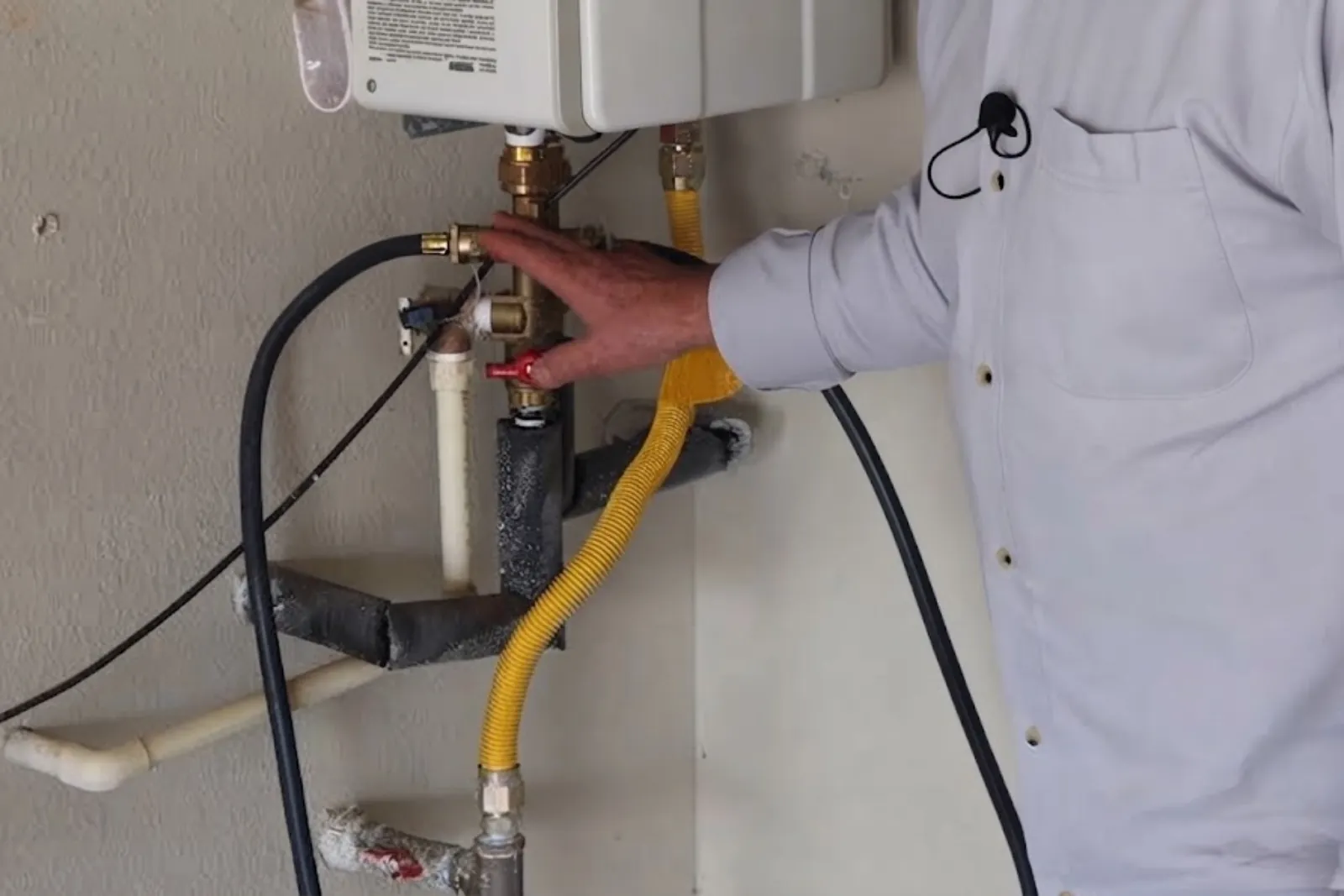
Why tankless heaters need regular flushing
Inside a tankless unit, water passes through a narrow heat exchanger that gets very hot very fast. Any hardness minerals left in the water can form scale there, which reduces flow and makes the unit work harder.
Hamilton's city water is lime-treated at the treatment plants before it reaches taps, which lowers its hardness, but it still carries some minerals. Homes on private wells in the surrounding townships get untreated aquifer water and usually see scale much faster.
Many manufacturers call for a vinegar or descaling-solution flush about once a year, and more often on well water. The water connections follow the Ohio Plumbing Code, based on the 2021 International Plumbing Code (IPC), while gas venting follows the manufacturer's instructions and the Ohio Mechanical Code.
What a service visit includes
- With the service valves shut, a small pump cycles cleaning solution through the unit for about an hour.
- The inlet water filter screen is removed and cleaned.
- Error history is read from the unit where the model allows it.
- Venting and the condensate line on condensing models are checked.
- Gas pressure is measured under load, since an undersized gas line causes many mid-shower cold spots.
Error codes and cold-water sandwiches
The brief burst of cold water between two hot ones is common on tankless units and often normal when a tap is turned off and on quickly. If it happens during a steady shower, low gas pressure, a dirty inlet screen or a failing flow sensor are likelier causes.
Error codes differ by brand. Ignition and flame failure codes after winter storms often trace to blocked intake vents or frozen condensate lines. Our honest limit: some older or discontinued units cannot get parts, and when that is the case, we tell you before charging for a repair that cannot be completed.
Tank or tankless for your next replacement?
A tankless unit is not automatically the upgrade. It usually needs a larger gas line and new venting, and it costs more to install than a tank. It makes most sense for households that run out of hot water regularly or need the floor space.
If you are still weighing the choice, our water heater replacement page compares tank, heat pump and tankless options. If mineral buildup is a recurring problem, a water softener in front of the heater may be worth considering, especially on well water.
Flushes, error codes and repairs, not just replacement
Tankless owners call for two reasons: a yearly flush, or an error code with the unit beeping or shutting down. Many have been told the unit cannot be serviced and must be replaced, which is often not the case.
A flush descales the heat exchanger by pumping a solution through the service valves. Error codes point to ignition, flame sensing, venting or water flow, so the code number is the first thing to give on the call.
Tankless service in Hamilton and nearby
We service tankless heaters in ZIP codes 45011, 45013 and 45015. Owners on private wells in Ross Township see the fastest scale buildup and benefit most from a yearly flush.
Most tankless units we service sit in newer homes in Liberty Township, West Chester and Fairfield Township, plus a growing number of renovated older houses near downtown Hamilton where owners wanted the basement space back.
What tankless service costs depends on
A routine descale costs much less than a component repair. These factors decide it.
- Maintenance or repair. A flush and filter clean is a set routine.
- Parts. Flow sensors, igniters and fans vary widely by brand.
- Missing isolation valves. Units installed without service valves need them added before flushing.
- Venting fixes on units that trip after storms.
- Timing. After-hours calls cost more than scheduled service.
Maintenance and wear are not covered by insurance. A manufacturer warranty may require proof of regular descaling, so keep your service receipts.
Want your real number? Call (513) 796-9381 and describe what you are seeing.