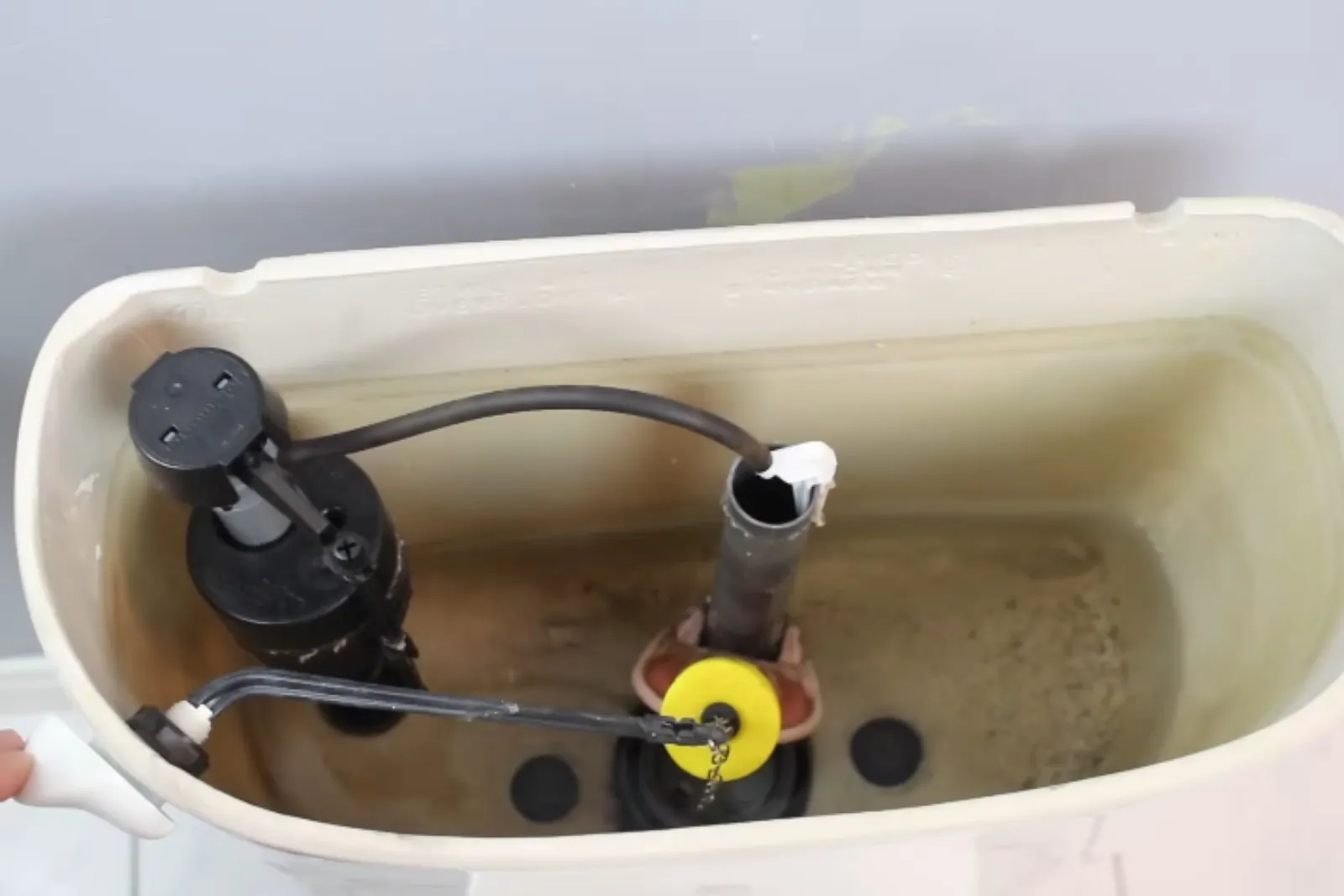
The most common toilet repairs
| Problem | Usual cause | Repair |
|---|---|---|
| Runs constantly | Worn flapper or fill valve set too high | Replace the flapper or fill valve. |
| Water at the base | Failed wax ring or loose closet bolts | Pull the toilet and reset on a new seal. |
| Weak flush | Low tank level or mineral-clogged rim holes | Adjust the fill level and clear the holes. |
| Tank leaks at the bolts | Worn tank-to-bowl gasket | Replace the gasket and bolts. |
| Frequent clogs | Low-flow bowl design or a partial main clog | Snake the toilet and check the main. |
Toilet emergencies that cannot wait
An overflowing bowl, water spreading from the base, or a toilet that gurgles while the tub or floor drain backs up all need fast attention. The last one usually means the main line is blocked, not the toilet, so plunging harder only pushes more water out.
Turn the oval valve behind the toilet clockwise to stop the tank refilling, and stop using water elsewhere in the house. If that valve is stuck or crumbling, close the main. Then call and say which fixtures are backing up.
Why a small leak at the base matters
The wax ring seals the toilet to the drain flange. When it fails, water seeps under the toilet on each flush, often without showing much on the surface. In older Hamilton homes with wood subfloors over basements, that slow leak can soften the floor and stain the ceiling below.
If the toilet rocks, the seal cannot stay tight. Resetting it involves new bolts, a new ring, and sometimes a flange repair. Check the basement ceiling under the bathroom for stains, since that is often the first sign.
Test for a silent leak in two minutes
- Add some food dye to the tank water, leaving the bowl alone.
- Do not flush for 15 minutes.
- Dye showing up in the bowl means water is slipping past the flapper.
- That slow slip is behind many unexplained jumps in the water bill.
If the bill is still high after fixing the toilet, our leak detection service can find what else is leaking.
Replacing a toilet
A new toilet makes sense when the bowl is cracked, the toilet clogs constantly, or it uses several gallons per flush. Modern models use far less water, and the Ohio Plumbing Code, based on the 2021 International Plumbing Code (IPC), caps new toilets at 1.6 gallons per flush. Older bathrooms sometimes have an unusual rough-in distance from the wall, so that gets measured before choosing a new one.
If a toilet clogs every week and others in the house are slow too, the problem may be in the main line, covered on our drain cleaning page.
Supply lines and shutoff valves
The small supply line between the wall valve and the tank is a common leak point. Older solid lines crack and plastic nuts fail. A braided stainless line costs little and is worth replacing whenever the toilet is worked on. If the shutoff valve will not close fully, it should be replaced too, since it is the only quick way to stop an overflow.
Common toilet calls and how they are priced
Toilet calls range from a broken flush lever or a fill valve that keeps running, to a wax ring leaking at the base, to swapping round bowls for elongated ones. Callers also ask whether removing the old toilet is included in an installation price, so ask that directly with any quote.
Toilets running at random in two bathrooms are a common cause of a high water bill, and the dye test on this page confirms it. A toilet that gurgles or will not drain while other fixtures are slow points to the main line, covered on our drain cleaning page.
Toilet repair in Hamilton and nearby
We repair and install toilets in ZIP codes 45011, 45013 and 45015. Landlords with student rentals in Oxford call often for running toilets and broken tank parts between tenants.
Toilet calls come from everywhere, but older bathrooms in Highland Park, Prospect Hill and Lindenwald often have odd rough-in distances or failing original shutoff valves that change the job.
What toilet repair costs depends on
Most toilet repairs are quick. These factors raise or lower the price.
- The part: flapper, fill valve, gasket or wax ring.
- Pulling the toilet for seal or flange work.
- Flange or subfloor damage found underneath.
- New toilet supply and installation.
- Timing of the visit.
Toilet parts are maintenance. Damage from a sudden overflow may be covered, but slow leaks under the toilet usually are not.
Want your real number? Call (513) 796-9381 and describe what you are seeing.