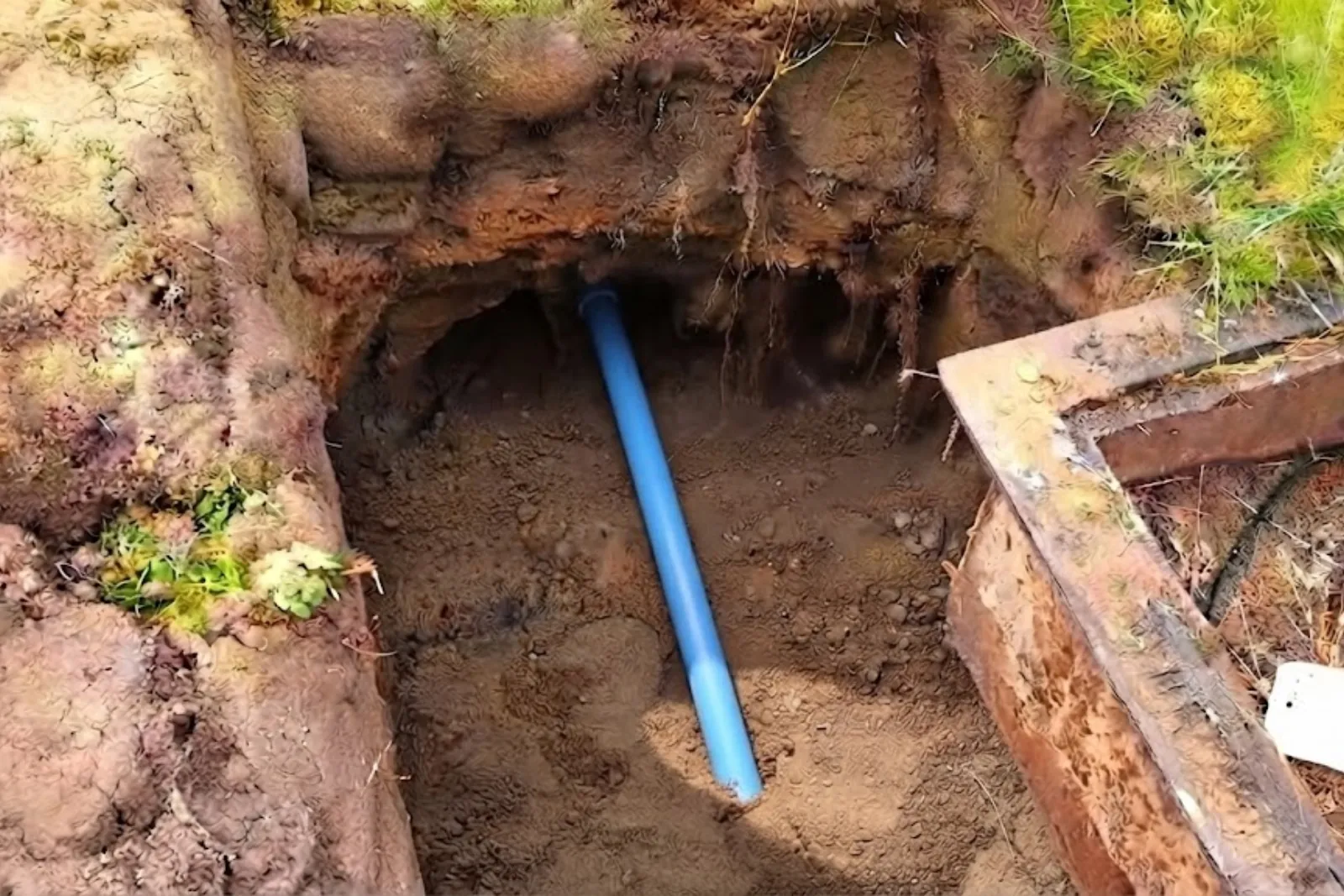
Meter spinning, soggy lawn or low pressure everywhere?
Most owners never see their service line. What they notice is the result. A bill that climbed while your habits stayed the same, a meter that keeps moving when nothing is running, or a patch of yard that never dries all point to a leak between the curb stop and the house.
A quick test helps. Turn off every faucet and appliance, note the meter reading, and wait 30 minutes without using water. If it moved, something is leaking. Then close the main shutoff inside the house and check again. If the meter still moves, the leak is on the buried service line rather than inside the house.
Water line emergency: water in the yard or none in the house
Two situations make a service line an emergency. One is water coming up in the yard or seeping into the basement where the line passes through the foundation. The other is a house that suddenly has no water while the bill is paid and the neighbors still have pressure.
Hamilton splits the line at the curb stop. The city's part runs from the main to the curb stop, and the line from the curb stop into the house belongs to the owner. A break on the street side is the city's to fix, and a break on your side is the repair we handle.
Lead service lines in Hamilton: what the city covers and what you own
Hamilton's water utility, operated by the city since 1884, is replacing lead service lines under the federal Lead and Copper Rule. The city built a service-line inventory, used a prediction model to estimate materials where records are missing, and made the map public. Customers with known or possible lead lines were notified by mail.
Responsibility splits at the curb-stop valve. The city's program covers the public stretch from the main to the curb stop. Past the curb stop, the pipe into your house belongs to you, and so do its repairs and eventual replacement.
The best time to replace the private side is when the city is working on your street, since the trench and the water shutoff can be coordinated. Replacing only half of a lead line can temporarily disturb the remaining lead, so both sides should be done around the same time where possible.
Check your own line before you call
- Look up your address on the city's public service-line map.
- Find where the water pipe enters the basement, usually before the meter.
- Scratch the pipe gently with a key. Lead shows shiny silver and is soft.
- A magnet will not stick to lead or copper. It will stick to galvanized steel.
- If it looks like lead, run the cold tap until it turns noticeably colder before drinking, and use cold water for cooking.
Repair or full replacement?
A single leak on a copper or plastic line in otherwise good condition can often be dug out and repaired with a compression or brass coupling. A lead line or an old galvanized line should be replaced, not patched, because the rest of the pipe is the same age and material as the part that failed.
Replacement pipe is usually type K copper or a polyethylene service tubing rated for buried potable water. Both are proven. The choice depends on soil, length and how the line will be installed.
| Method | How it works | Best fit |
|---|---|---|
| Open trench | Dig from the curb stop to the house and lay new pipe | Short runs and open lawns. |
| Pull-through or pipe bursting | Drag the new line along the old route between two small pits | Lines under mature trees, walks and landscaping. |
| Directional boring | Bore a new path beneath the surface between two pits | Runs under a driveway or where the old path cannot be reused. |
The Ohio Plumbing Code, based on the 2021 IPC, requires water service pipe to be protected from freezing, so the new line has to be buried deep enough to stay below frost, and it ties into a new shutoff inside the house. It is pressure-tested before the trench is closed.
How the curb stop and permits work
The curb stop is the valve at the property line that shuts off water to the house. It is utility equipment, so a replacement is coordinated with the city water department rather than done by forcing an old valve. Water line replacement is typically permitted work in Hamilton, pulled by a contractor with a city Master Registration.
Utility marking through Ohio 811 comes before any digging. On a planned replacement, water is usually off for part of one day. If the old line is leaking badly, a temporary repair can stop the water loss while the permanent job is scheduled.
No water, a soggy yard, or low pressure at every tap
Service line calls usually start one of three ways. Water is coming out of the ground near the meter box, the house has no water at all, or pressure has dropped at every fixture at once. Low pressure at one faucet is usually that faucet. Low pressure everywhere points to the service line, the main valve or the meter.
Homes on private wells in Ross Township and Hanover Township have their own version of this: a leak in the buried line between the well and the house or barn. The search is the same, isolating sections and listening along the line, while the pump and pressure tank are a separate system.
Leaks under driveways and other buried lines
When the leak is under a driveway or sidewalk, callers ask whether the concrete has to be saw cut. Sometimes it does, but a new line can often be pulled or bored alongside the old one instead.
Hamilton's own plumbing and sewer permit application says the city does not recommend polyethylene pipe for the water supply. Ask what material a replacement quote assumes before the new line goes in.
Water line work in Hamilton and nearby communities
We repair and replace service lines in ZIP codes 45011, 45013 and 45015. Lead and galvanized lines are most likely on older houses near the historic districts, while newer neighborhoods more often have copper or plastic lines that fail at a fitting.
Homeowners in Fairfield are served by a separate water system, so ownership rules there follow that city's policy. If the pipes inside your house are also galvanized or lead-soldered, our repiping page covers replacing them in the same project.
Lead and galvanized service lines are most likely on older houses in German Village, Dayton Lane, Rossville and Lindenwald. Homes in Fairfield Township are on Butler County Water & Sewer, which buys its water from Hamilton, but the private line past the meter is still the owner's to maintain.
What determines the price of a water line job
No two service lines are the same length or depth. These factors set the price.
- Length of the run from the curb stop to where the line enters the house.
- Installation method. Pulling or boring costs differently than an open trench, and saves landscaping.
- What is on top. Driveways, walks, trees and retaining walls add work or require trenchless methods.
- Pipe material and the new shutoff valve inside the house.
- Permits and city coordination for the curb stop connection.
Homeowners insurance rarely pays to replace an aging service line. Some policies or add-on plans cover service line breaks, and lead line programs may offset part of the cost, so check with your insurer and the city before the work starts.
Want your real number? Call (513) 796-9381 and describe what you are seeing.