Who owns the sewer line under your Hamilton yard
This is the first thing Hamilton owners ask, and the city code is clear. Section 931.031 makes the property owner responsible for installing the sanitary lateral from the house to the public sewer, and for maintaining, repairing or replacing it from then on. That includes the stretch under the sidewalk and street, all the way to where it meets the city main.
The code also says that if the city finds the lateral in the right-of-way was damaged by the owner or the owner's contractor, the owner pays for that repair too. So before anyone digs near the street, it pays to know exactly where the pipe runs and how deep it is. The city maintains its main. The lateral is yours.
Sewer emergency: sewage backing into the house
Sewage coming up through a basement floor drain, a lower toilet or a shower is the sewer call that cannot wait. It usually means the lateral between the house and the public sewer is blocked by roots, grease or a collapsed section.
Stop all water use, keep people away from the wet area, and do not run a rented machine through a line that may be broken. The line is cleared first so the house is usable, then a camera shows whether the lateral needs repair.
What Hamilton sewer laterals are made of
The material tells you how the pipe usually fails, and which repair methods will work on it.
| Pipe material | Where it turns up | How it usually fails |
|---|---|---|
| Clay tile | Older homes in the historic districts and early 1900s streets | Roots at the joints, cracked or offset sections. |
| Cast iron | Inside the house and under basement floors of older homes | Scale buildup, rusted-through bottom, cracked hubs. |
| Fiber pipe (Orangeburg) | Some postwar houses | Softens, flattens and blisters with age. |
| PVC | Newer homes and past repairs | Joint separation if the soil settled, or damage from later digging. |
Many older Hamilton laterals are a patchwork of several of these, which is one more reason to look with a camera before choosing a repair.
How we find the damage before anyone digs
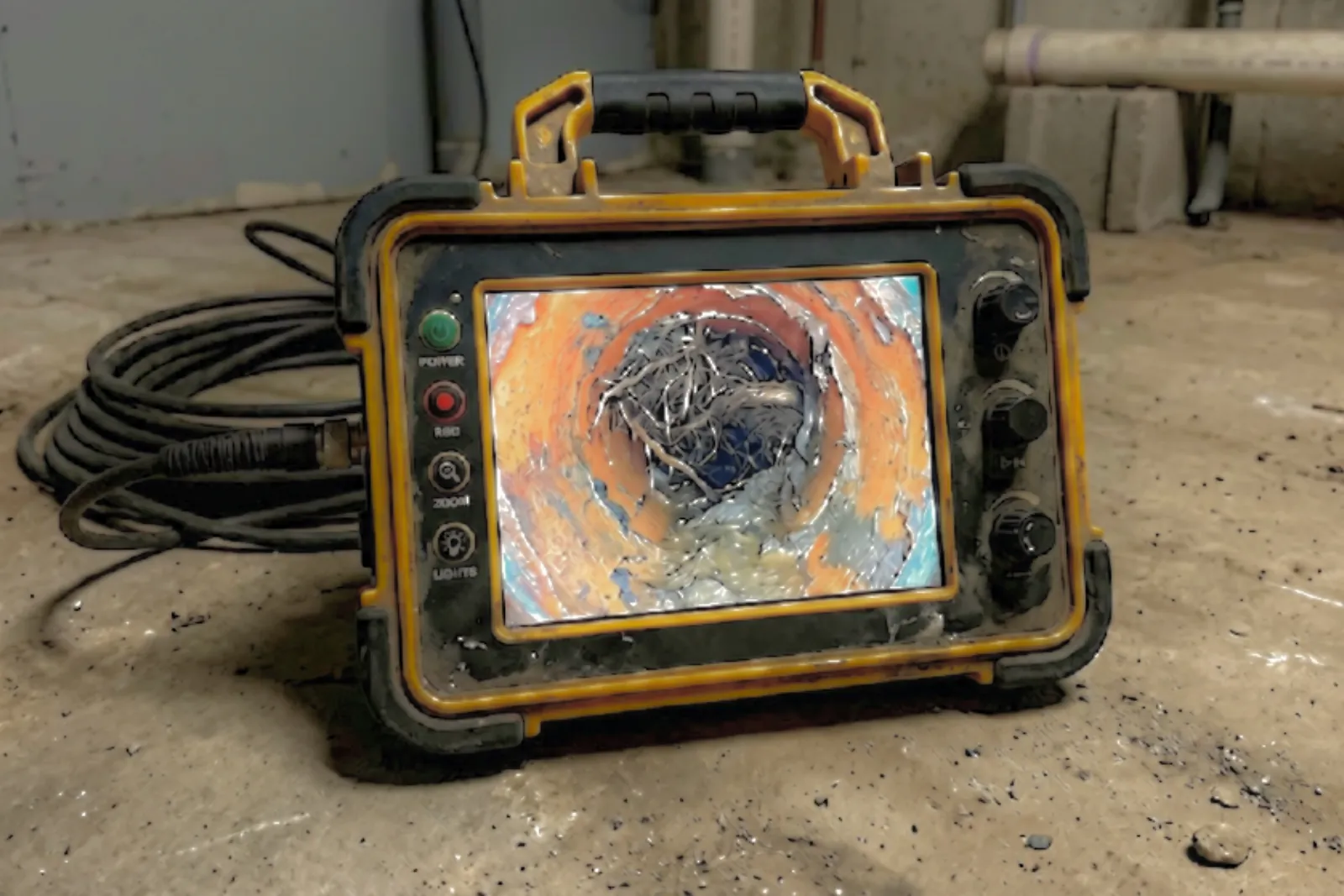
The line is cleared first so the camera can see. A self-leveling camera head goes in from the basement cleanout and records the full run to the main. The footage shows the pipe material, every joint, roots, bellies where water pools, and breaks.
A transmitter in the camera head lets us mark the exact spot and depth of each problem from the surface. That turns a vague "somewhere under the front yard" into a single point, which keeps any excavation small. You get to see the footage and keep a copy.
Repair methods, and when each one makes sense
There is no single right answer for a damaged lateral. The choice depends on how much of the pipe is bad and what is on top of it.
- Spot repair. One cracked or offset section is dug out and replaced with PVC and shielded couplings. Best when the rest of the pipe is sound.
- Pipe lining. A resin-soaked liner is pulled into the old pipe and cured in place, making a new pipe inside the old one. It works well for root-invaded clay under a driveway, a mature tree or a finished walkway.
- Full replacement. When the pipe is flattened, badly sagged or failing along its whole length, a new line is the only lasting fix. Our sewer line replacement page covers trench and trenchless options.
- Maintenance cleaning. If roots are minor and the pipe is intact, scheduled cleaning with hydro jetting can be the honest cheapest answer for now.
A liner cannot fix a pipe that has collapsed or has a deep belly, because the liner follows the shape of the old pipe. That limitation should be explained before you sign anything.
Permits and working near the street
Sewer work in Hamilton that needs a permit must be pulled by a contractor holding a city Master Registration. Work that opens the sidewalk or street also has to be coordinated with the city, and utilities have to be marked before digging. Ohio's call-before-you-dig service is reached by dialing 811.
These steps add a few days to a planned repair. For a true emergency, such as sewage backing into a basement with no way to use the drains, the line is cleared first so the house is usable while the permanent repair is scheduled.
Roots, smells and spot repairs
Sewer calls often describe roots pulled out on a cable, a sewer smell in one bathroom, or a known crack where a spot repair might do instead of a full replacement. A camera inspection shows which of those fits.
A smell with no backup is often a dry trap or a failed wax ring rather than the lateral. A trap that will not hold water can mean a leak in the trap itself.
Septic lines in the townships
Outside the city sewer area, some homes still drain to a septic tank. A backup there can be the line from the house to the tank, which a plumber can clear or repair, or the tank and leach field, which go to a septic contractor.
The Butler County General Health District oversees household sewage treatment systems under Ohio Administrative Code Chapter 3701-29. Our guide to well and septic homes near Hamilton explains who handles which part.
Sewer line repair in Hamilton and surrounding towns
We work on laterals across ZIP codes 45011, 45013 and 45015. The oldest clay lines are concentrated in the historic core and nearby blocks, while repairs in newer areas are more often joint separations or damage from later landscaping.
Owners near Miami University in Oxford call about rental properties with the same aging laterals. If your immediate problem is a backed-up drain rather than a known break, start with drain cleaning and a camera look.
Hamilton's oldest laterals run under the historic districts and the older west side streets of Prospect Hill and Highland Park, where mature trees line the tree lawns. Lindenwald, annexed into the city in 1908, has many laterals of the same era.
What sewer line repair costs depends on
Sewer quotes vary widely because the jobs vary widely. These factors explain most of the difference.
- Depth and location. A shallow break in the yard costs far less than one under the street.
- Method. A single spot repair, a liner and a full replacement are priced very differently.
- Surface restoration. Cutting and replacing a driveway, sidewalk or street patch adds cost.
- Permits. City permits and inspections are part of the price on permitted work.
- Length of bad pipe. The camera footage decides how many feet actually need work.
Standard homeowners policies usually exclude sewer lines worn out by age or roots. A few insurers and some utilities sell service line coverage. Sewage damage inside the house may be covered only with a sewer backup endorsement.
Want your real number? Call (513) 796-9381 and describe what you are seeing.